
- HOME
- Sustainability
- Approach to Sustainability
Approach to Sustainability
Promoting Sustainability Management
In the Medium-Term Business Plan (FY2026-FY2030) announced in May 2026, the Group set forth a new long-term vision: "From a ‘demand-driven’ passenger terminal operator to a ‘demand-creating’ anchor at the airport (‘Anchor Role’,) realizing co-creation and expanding the results nationwide.," toward the realization of "To Be a World Best Airport ~ An airport that contributes to maximizing the number of air passengers in Japan ~."
To achieve our vision for 2030 of "Becoming one of the most advanced, human-and eco-friendly airports" and "Trusted by all stakeholders as the Anchor at Haneda Airport," we will enhance corporate value by positioning responses to our five materialities (key issues) as the foundation of our strategies.
In advancing our management strategy, we will establish KPIs (Key Performance Indicators) associated with these materialities and strengthen the effectiveness of our sustainability management initiatives. Through these efforts, we aim to contribute to the realization of a sustainable society.
*Covers the Japan Airport Terminal Group (including 19 consolidated company).
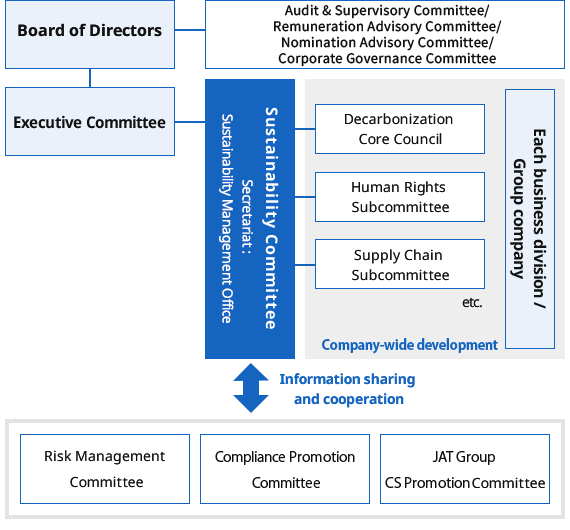
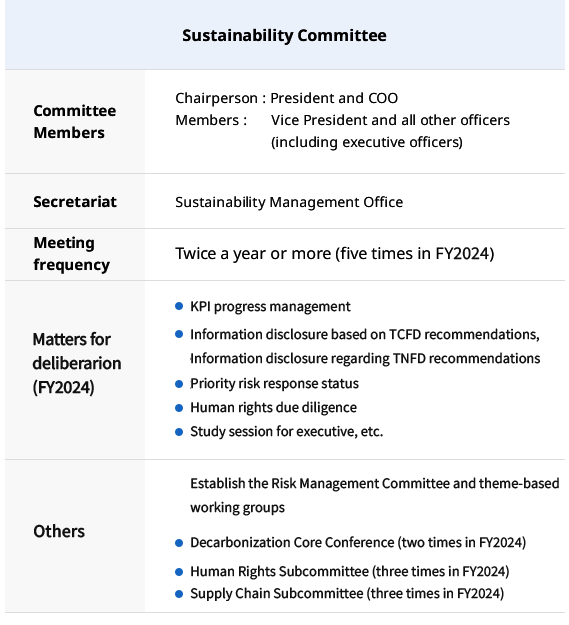
Our System
Review of Materiality
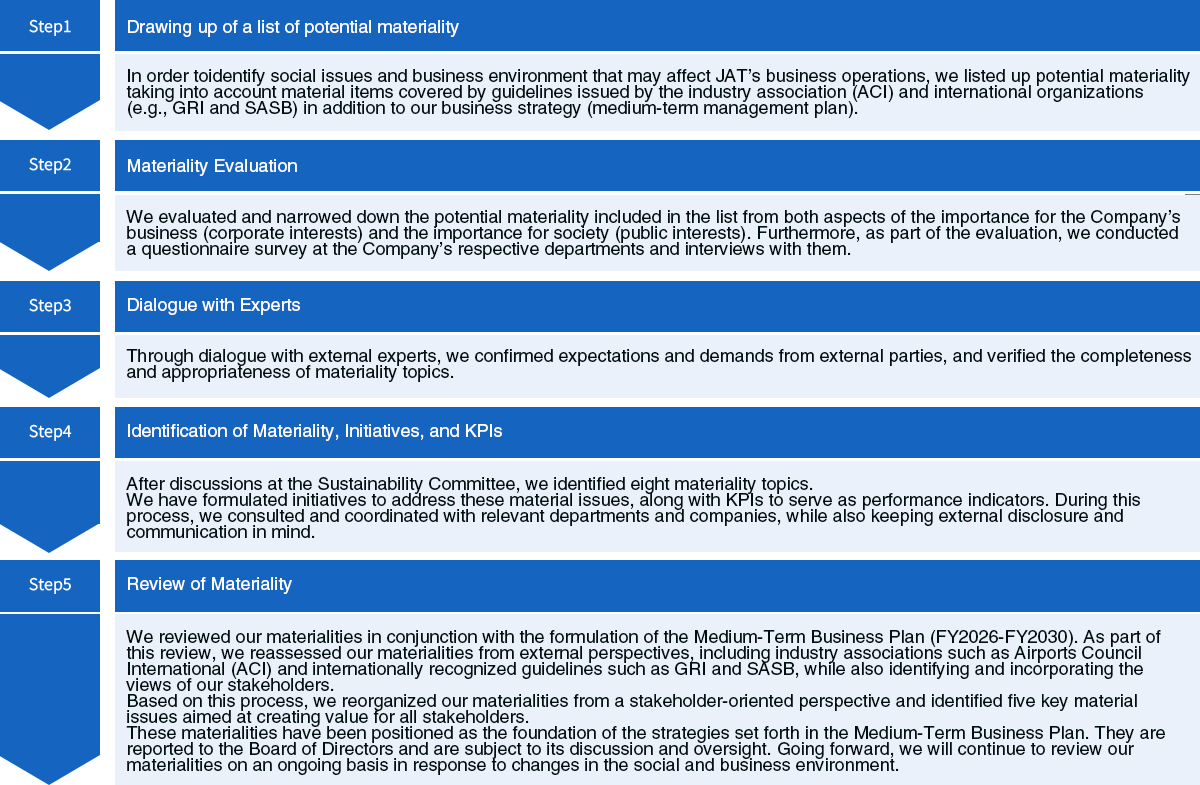
In the Medium-Term Business Plan (FY2026-FY2030) , we have defined our target vision for this period as serving as the "Anchor Role" for Haneda Airport as a whole. To fulfill our commitment to contributing to all stakeholders surrounding Haneda Airport and our Group, we have restructured our material issues with a stakeholder-centric approach.
Materiality Identification Process
New Materiality
- We reviewed our materialities to support the realization of our long-term vision. By positioning responses to our materialities as the foundation of our strategies, we will enhance corporate value through a series of initiatives.
- Under our sustainability promotion framework, progress on initiatives to address our materialities is reported to and discussed by the Board of Directors semiannually and is subject to its oversight.
Updated on June 22, 2026
| Materiality | Related stakeholders | Approach to materiality |
|---|---|---|
 Development of a Safe, Development of a Safe, Comfortable and Advanced Airport |
Passengers, Business Partners, Employees |
As an airport situated in the capital region, Haneda Airport is an important piece of public infrastructure that supports the social and economic activity of the movement of people. Given the aging of the population in Japan and the government target of 60 million overseas visitors to Japan, we expect the number of passengers needing appropriate attention such as overseas visitors, the elderly, and those with disabilities to increase further, and therefore it is an important social challenge to establish an air transport foundation leveraging advanced technologies and other means. Along with increasing the operational efficiency by using data and through co-creation with business partners, improving the convenience of passengers will help us to respond to the increase in international passengers, maintain domestic passenger numbers, and improve passenger satisfaction. We therefore recognize that this is a key challenge also from the perspective of sustainable business operations of the JAT Group. |
 Contribution to Local Communities Contribution to Local Communities |
Local Communities, Business Partners |
The decrease in Japan’s population due to the falling birthrate and aging of society may also lead to stagnation of local economies and is considered a social issue that could bring about a decline in the country’s economic power. The JAT Group’s business is supported by the movement of people to and from the capital region to various parts of the country. Maintaining passenger levels domestically, therefore, is a key challenge for us. As we continue to sustain our operations, it is increasingly important that we utilize Haneda Airport, used by a large number of passengers, to the maximum extent by popularizing the charms of various regions and in co-creation with our business partners to initiate interactions with these regions and create demand for the domestic movement of Japanese people and foreign tourists. |
 Eco-friendly Business Operations Eco-friendly Business Operations |
Global Environment, Business Partners |
The increasingly severe and frequent weather events are impediments to achieving sustainable socio-economic development and also affect the smooth operation of the aviation-related businesses. The transition to a decarbonized society by reducing GHG emissions and treatment of waste that impacts the natural environment entail significant costs. The JAT Group is dependent on natural capital as it consumes a large amount of electricity in its passenger terminal operations. It also generates a large volume of waste that impacts the environment. We therefore recognize that it is important for us to promote decarbonization and build a mechanism for resource recycling in our supply chains from the perspective of sustainable business operation. |
 Fair and Resilient Business Activities Fair and Resilient Business Activities |
Passengers, Business Partners, Employees, Shareholders and Investors |
For the JAT Group, which engages in the highly public business of operating passenger terminals, it is significantly important to establish highly transparent governance in compliance with laws and regulations and to ensure risk management in a society where natural disasters, cyber-terrorism, etc. are occurring frequently. They are key factors for us to continue as an operator of an airport function facility trusted by society and other stakeholders. |
 Strengthening Human Capital and Strengthening Human Capital and Promoting Human Capital Management |
Employees, Passengers |
With Japan’s population declining due to the falling birthrate and other factors, it is becoming increasingly difficult to secure human resources that would sustain Japan’s socio-economic structure. Businesses are required to have better diversity and inclusivity in addition to fairness and appropriate treatment from socio-economic sustainability and revitalization perspectives, and the difference in the capability of human resources will be what differentiates the business management of companies. Human capital is the most important resource to conclusively achieve the long-term vision. In this respect, our key challenges are to develop human resources who act flexibly with an insatiable curiosity, lead all involved parties, and proactively communicate; raise the per capita productivity; and continuously secure and nurture airport management professionals who respect diverse cultures and perspectives for operating a passenger terminal that welcomes people from all over the world and from different regions of Japan. |