
- HOME
- Sustainability
- Approach to Sustainability
Approach to Sustainability
Promoting Sustainability Management
In the Medium-Term Business Plan (FY2026-FY2030) announced in May 2026, the Group set forth a new long-term vision: "From a ‘demand-driven’ passenger terminal operator to a ‘demand-creating’ anchor at the airport (‘Anchor Role’,) realizing co-creation and expanding the results nationwide.," toward the realization of "To Be a World Best Airport ~ An airport that contributes to maximizing the number of air passengers in Japan ~."
To achieve our vision for 2030 of "Becoming one of the most advanced, human-and eco-friendly airports" and "Trusted by all stakeholders as the Anchor at Haneda Airport," we will enhance corporate value by positioning responses to our five materialities (key issues) as the foundation of our strategies.
In advancing our management strategy, we will establish KPIs (Key Performance Indicators) associated with these materialities and strengthen the effectiveness of our sustainability management initiatives. Through these efforts, we aim to contribute to the realization of a sustainable society.
*Covers the Japan Airport Terminal Group (including 19 consolidated company).
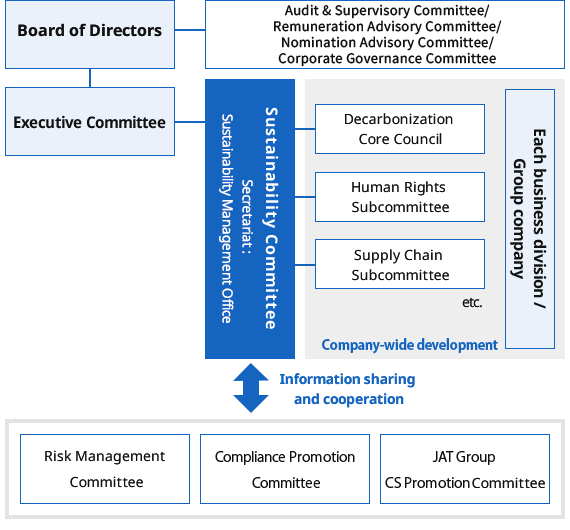
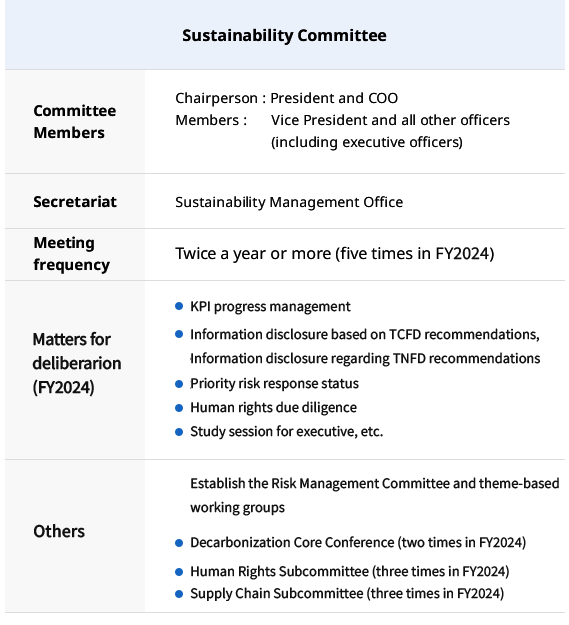
Our System
Review of Materiality
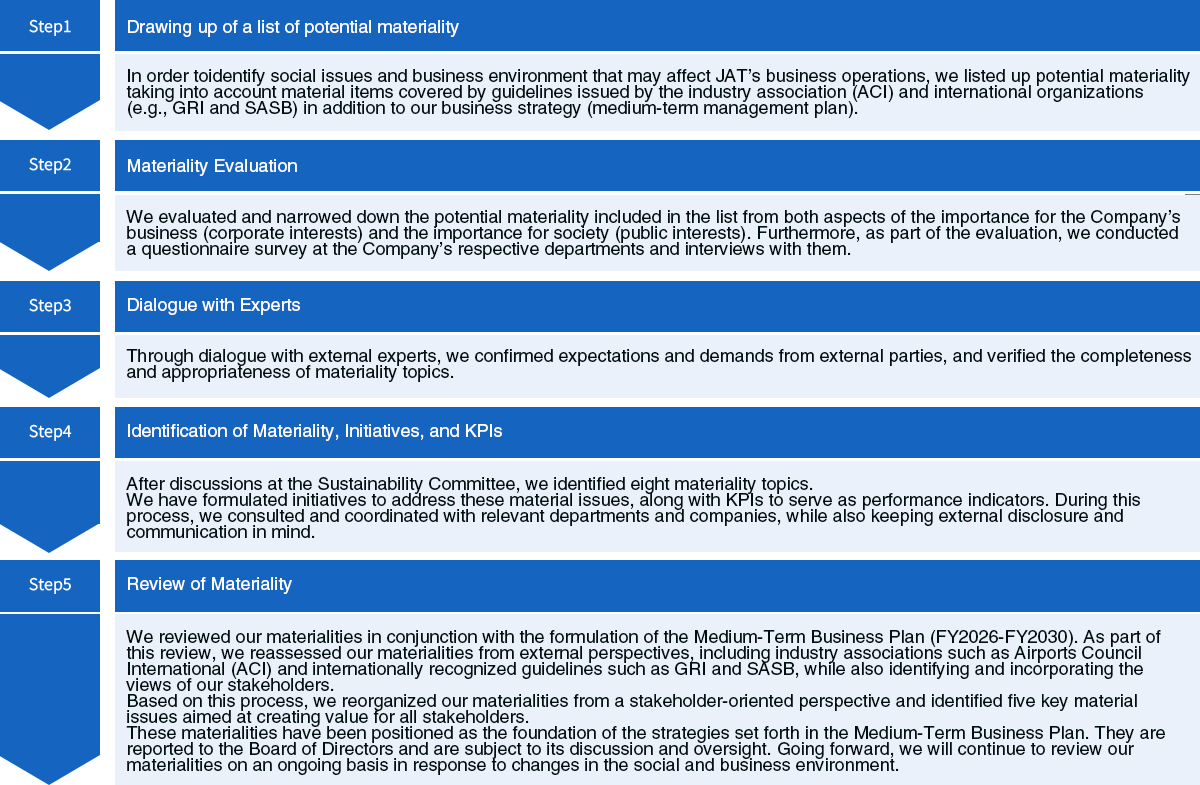
In the Medium-Term Business Plan (FY2026-FY2030) , we have defined our target vision for this period as serving as the "Anchor Role" for Haneda Airport as a whole. To fulfill our commitment to contributing to all stakeholders surrounding Haneda Airport and our Group, we have restructured our material issues with a stakeholder-centric approach.
Materiality Identification Process
New Materiality
- We reviewed our materialities to support the realization of our long-term vision. By positioning responses to our materialities as the foundation of our strategies, we will enhance corporate value through a series of initiatives.
- Under our sustainability promotion framework, progress on initiatives to address our materialities is reported to and discussed by the Board of Directors semiannually and is subject to its oversight.
Updated on August 31, 2026
| Materiality | Approach to Materiality | KPI | Target Value (FY2030) |
|---|---|---|---|
 Development of a Safe, Development of a Safe,Comfortable and Advanced Airport (Customers, Partners and Employees) |
Haneda Airport, located in the Tokyo metropolitan area, is an essential public infrastructure supporting social and economic activities through the movement of people. With the aging of Japan's population and the government's target of 60 million inbound visitors, the number of customers requiring special consideration, including inbound visitors, the elderly, and people with disabilities, is expected to increase further. Ensuring a reliable air travel infrastructure through the use of advanced technologies has therefore become an important social issue. Improving operational efficiency through data utilization and co-creation with partners, while enhancing customer convenience, will help accommodate the increase in international passengers, maintain domestic air passenger numbers, and improve customer satisfaction.
We recognize these as important issues for the Group’s sustainable business operations. |
SKYTRAX World's Best Airport | Maintain a Top 3 position |
| Creating Value-added Time (Percentage of Security Screening Wait Times of Five Minutes or Less) |
95% (Domestic Flights) | ||
| HANEDA App: Sales and Number of Member Downloads |
2.0 million downloads; member spending of ¥20,000 per person |
||
 Contribution to Local Contribution to LocalCommunities (Local Communities and Partners) |
The decline in Japan's population due to the declining birthrate and aging population could lead to the decline of regional economies and is regarded as a social issue that could weaken Japan's economic strength. For the Group, whose business is supported by the movement of people between the Tokyo metropolitan area and regional areas, maintaining domestic air passenger numbers is recognized as an important issue. Making the most of Haneda Airport as a platform used by many customers to promote the appeal of regional areas, as well as creating opportunities for interaction with local communities and generating domestic air travel demand among Japanese nationals and inbound visitors through co-creation with business partners, are recognized as important issues for sustaining the Group's business.
|
Off-terminal revenue at Haneda Airport |
+30% (vs.FY2025) |
| Number of External Expansion Projects Contributing to Increased People Flows through Regional Co-creation (Airport OS/DX, Passenger Attraction/Tourism, Commercial/Sales Channels, Airport Business, Metropolitan/Broad Area) |
Dialogues and proposals: 10 or more cases per year (FY2026) / Implementation of collaborative measures: 10 or more cases cumulatively (FY2030) |
||
 Eco-friendly Business Eco-friendly BusinessOperations (Global Environment and Partners) |
The increasing severity and frequency of extreme weather events impede the sustainable development of society and the economy, affecting the smooth operation of aviation-related businesses.
Transitioning to a decarbonized society through greenhouse gas emission reductions and managing waste that places a burden on the natural environment
are recognized as social challenges entailing significant costs. As the Group consumes substantial amounts of electricity in operating passenger terminals,
relies on natural capital, and imposes environmental burdens by generating large amounts of waste, promoting decarbonization and establishing resource circulation systems
across the supply chain are recognized as important issues for sustainable business operations.
|
CO2 Emissions Reduction | -46% (vs. FY2013) Net Zero (FY2050) |
| Recycling Rate for Terminal Waste |
70% | ||
| Establishing a SAF Supply and Sales Framework as a Foundation for Airport GX |
Establish and Launch a SAF Supply and Sales Scheme in Collaboration with Relevant Business Operators |
||
| Building an Environmentally Conscious Supply Chain through Co-Creation with Suppliers |
Ethical Goods Fair: Once per year; Dialogue with Primary Suppliers: 10 companies per year |
||
 Fair and Resilient Business Fair and Resilient BusinessActivities (Customers, Partners, Employees, Shareholders and Investors) |
For the Group, which operates passenger terminals as an essential public infrastructure, establishing transparent governance
in compliance with laws and regulations and ensuring thorough risk management in a society where natural disasters and cyberattacks
occur frequently are recognized as important issues for maintaining operations as an airport facility operator based on trust from society and stakeholders.
|
Establishing Digital Governance (Obtaining DX Certification, etc.) |
Obtain DX Certification (FY2026) and Be Selected as a DX Stock (FY2030) |
| Number of Serious Misconduct and Violations in Corporate Activities |
0 cases | ||
| Compliance Rate with Sustainable Procurement Guidelines |
80% | ||
 Strengthening Human Capital Strengthening Human Capitaland Promoting Human Capital Management (Employees and Customers) |
Amid the ongoing decline in Japan's population due to the declining birthrate and other factors, securing human capital to support Japan's social and economic development is becoming increasingly difficult. From the perspective of social and economic sustainability and vitality, companies are required to promote diversity and inclusion while also improving fairness and appropriate treatment, and differences in workforce capabilities are considered to directly affect corporate management.
Human capital is the most crucial capital for steadily realizing our Long-Term Vision. We recognize that it is essential to develop talent who act proactively, with an insatiable spirit of inquiry, lead stakeholders, and communicate proactively; increase productivity per employee; and continuously secure and develop airport operations professionals who respect diverse cultures and perspectives as we welcome customers from around the world and across Japan and operate passenger terminals. |
Employee Engagement Index | 82 pt or higher |
| Educational Investment per Employee |
¥150,000 | ||
| Consolidated Operating income per employee |
¥10 million |
Review of the Medium-Term Sustainability Plan (FY2023–2025)
To further deepen and embed sustainability management, we formulated a medium-term sustainability plan in 2023. Under our sustainability promotion framework, we have been managing progress against KPIs, reviewing plans and targets, and driving initiatives to address material issues. Please refer to the relevant materials for a review of the medium-term sustainability plan. Regarding KPIs that have not yet been met, we will continue to monitor progress and strive to ensure timely and appropriate information disclosure and communication.
ESG Initiatives